Conflict diamonds
Conflict diamonds mean rough diamonds used by rebel movements or their allies to finance conflict aimed at undermining legitimate governments, as described in relevant United Nations Security Council resolutions, and as understood and recognised in United Nations General Assembly Resolution 55/56, or in other similar UNGA resolutions which may be adopted in future.

Kimberley Process: United in eradicating conflict diamonds
Kimberley Process is established to find a solution to the international problem of conflict diamonds, and the opportunity for conflict diamonds to play a role in fuelling armed conflict can be seriously reduced by introducing a certification scheme for rough diamonds designed to exclude conflict diamonds from the legitimate trade.

KP Trade Suspensions & UNSC Sanctions
.png?upscale=true&width=140&name=Frame%20119%20(3).png)
Enforcement of regulations
Participant countries must enforce stringent legal and regulatory standards to control the import and export of rough diamonds and ensure adherence to KP requirements.

Principles of transparency
Participants commit to transparent practices, which are crucial for the integrity of the diamond supply chain, by exchanging accurate and timely statistical data.
.png?upscale=true&width=140&name=Frame%20119%20(1).png)
Selective trading protocol
Trade is permitted only between certified KP members who comply fully with these international standards, safeguarding the legitimacy of the diamond trade.
.png?upscale=true&width=140&name=Frame%20119%20(2).png)
Verification of exports
Every diamond export is closely inspected and must be accompanied by a valid KP certificate, certifying that the diamonds are conflict-free to prevent the entry of illicit stones into the market.

Participants

Observers
Industry and civil society groups that play a pivotal role in monitoring the effectiveness of the KP, offering insights and support to strengthen the certification scheme.
Chair
The Chair represents the collective will of the Participants, as reflected in corresponding KP decisions, organizes the work for implementation of the adopted decisions and coordinates the official activity of the KP with other international organizations and mass media.

Subsidiary Bodies & Working Groups
The Plenary may establish and define the composition and the terms of reference of subsidiary bodies and ad hoc working groups. The subsidiary bodies and ad hoc working groups help to strengthen the implementation of the Kimberley Process Certification Scheme.
Secretariat
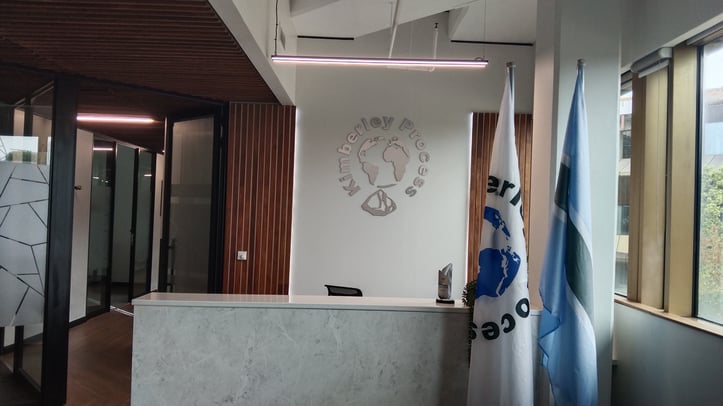
Enhances the work of the KP in a dedicated and professional administrative capacity and by providing continuity, institutional memory, operational efficiency, enhanced communication and outreach, and exchange of information within the KP and with relevant international organizations in support of activities of the KP.
.png?width=383&height=205&name=Frame%20130%20(2).png)
Candidates
Nations aspiring to join the KP, working towards fulfilling the necessary criteria to become full participants.

How to join?
Learn the steps required to become a candidate for Kimberley Process membership.






Bangladesh and New Zealand joined the Kimberley Process.








2000
2001
2002
2003
2004
2005
2006
Bangladesh and New Zealand joined the Kimberley Process.
2007
2008
2009
2010
2011
2012
2013
2014
2015
2016
2017
2018
2019
2020
2021
2022
2023
2024
2025